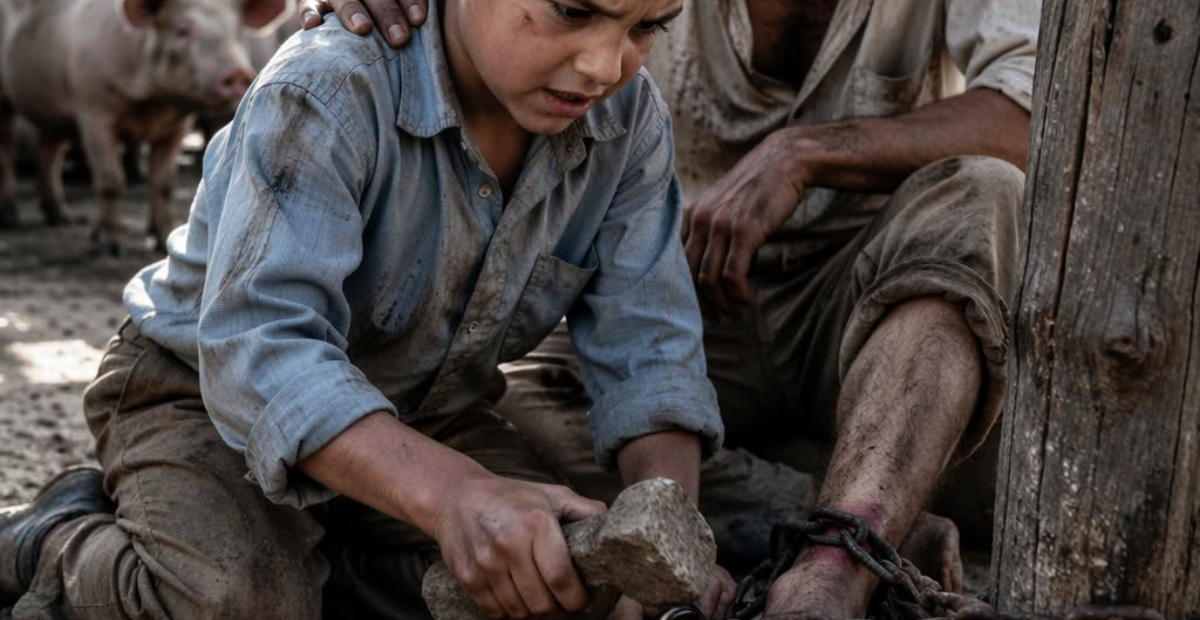
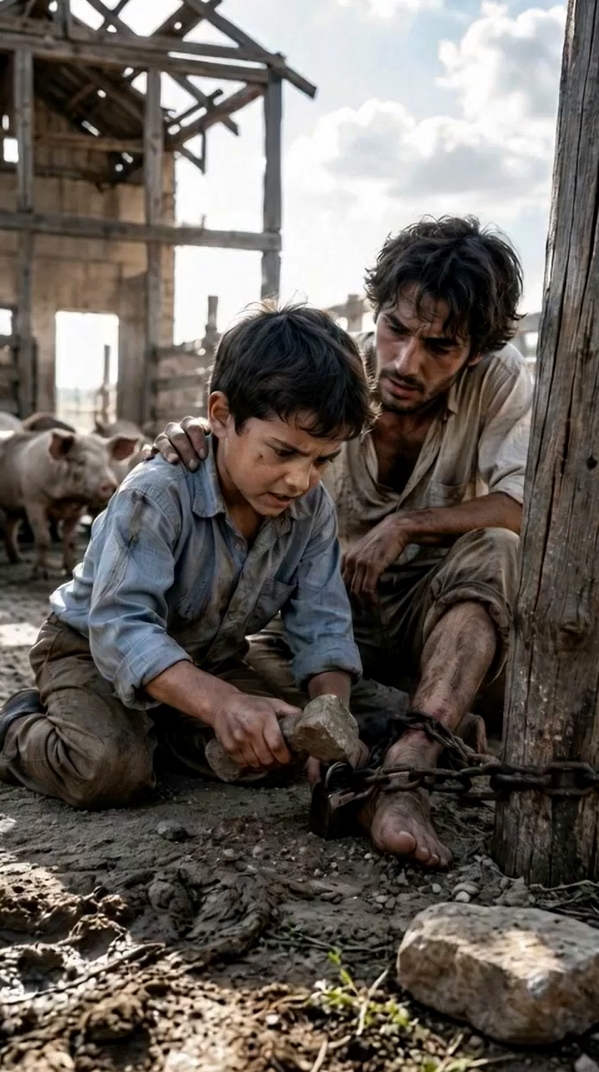
The boy had not meant to come this far. It started as curiosity, then concern, then something heavier he couldn’t name as he crossed the broken fence of the abandoned farm. The place looked swallowed by time—collapsed sheds, rusted tools, wind moving through dead grass like a warning. That’s when he heard it again: a faint, broken sound from beneath the old barn floorboards, like someone trying not to be heard.
He followed it.
Down in a narrow, hidden space beneath the barn, he found the man. Chains bound his wrists to a metal ring in the wall, his face streaked with dirt and exhaustion. His eyes, though, were alert—too alert. “Please,” the man whispered, voice rough as gravel. “They left me here. If you help me, I can get us both out.”
The boy hesitated only a moment before searching for a loose iron bar near the stairs. It took effort, fear pressing at his chest, but eventually the lock gave way with a sharp snap. The man staggered forward, rubbing his wrists, breathing like he had forgotten how to breathe freely. “We have to go now,” he said quickly, gripping the boy’s shoulder. “Before they come back.”
They climbed up together, moving through the barn’s rotten beams and broken doors. For the first time, the boy felt hope rising—maybe he had done something good, maybe this was the moment everything changed.
Then came the sound.
A low engine rumble, followed by gravel crunching outside the farm. It stopped abruptly, replaced by footsteps—many of them. The man froze mid-step. The boy turned toward the cracked barn door, his breath catching as beams of light swept across the walls. Flashlights. At least five.
The man whispered urgently, “Don’t move.”
But it was too late.
The doors burst open. Men and women in dark jackets filled the entrance, their movements sharp, coordinated. One of them shouted for everyone to stay where they were. The boy stepped back instinctively, but a familiar voice cut through the chaos.
“It’s okay,” the voice said.
From behind the group stepped a police officer, and for a moment the boy’s mind refused to accept what he was seeing.
It was his father.
The man on the ground suddenly changed—his posture collapsing from desperate to something colder. Resigned. Furious. “You lied,” he spat, looking at the boy instead of the officers. “You were bait.”
The boy’s father approached slowly, keeping his eyes on the freed man. “You were never chained here as a victim,” he said firmly. “You were contained here because you burned three houses and vanished before trial. We tracked you for months.”
The boy’s stomach dropped. The barn, the chains, the pleading voice—it all rearranged itself in his mind, twisting into something he had not seen coming.
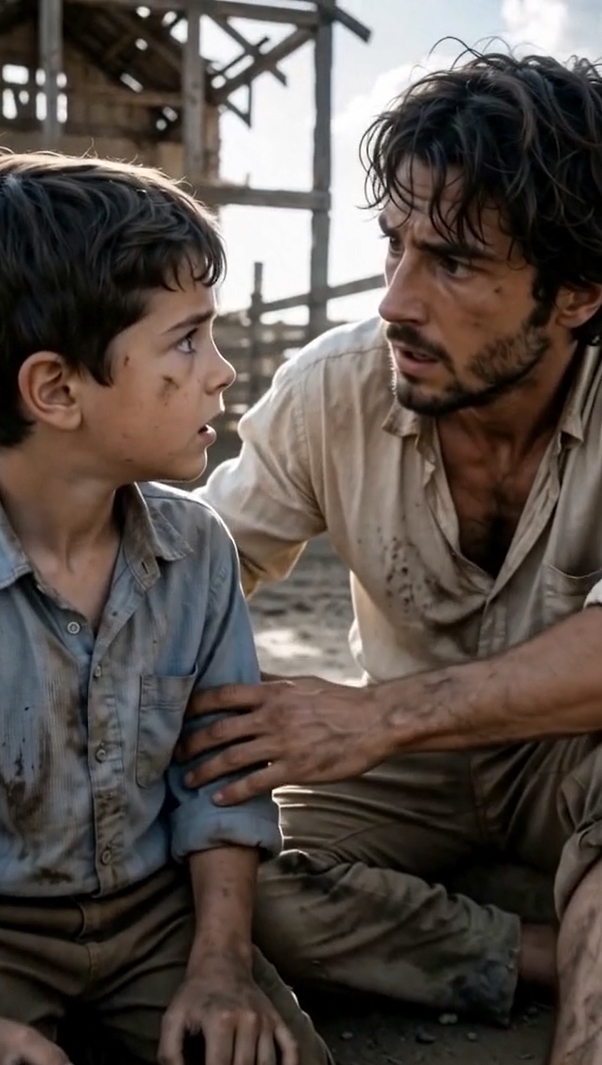
The man laughed once, sharp and humorless. “And you used a child to find me.”
The father didn’t answer that. Instead, he stepped closer and signaled the others. “Take him.”
As the officers secured the man again, now with reinforced cuffs, the boy stood frozen, unsure whether to feel fear, relief, or shame. His father knelt beside him after the truck lights faded outside.
“You did the right thing,” his father said quietly. “You stopped trusting fear and chose to help someone. That matters.”
“But he said—” the boy began.
“I know what he said,” his father interrupted gently. “That’s how people like him survive. Not with strength. With stories.”
The barn fell silent again, emptier than before, as if it had been holding its breath the whole time. The boy looked at the broken lock still hanging from the chain, realizing it had never been about freedom in the way he thought.
As they walked out into the night, the farm behind them shrinking into darkness, the boy understood something he couldn’t fully explain. Not everything that looks like a victim is one, and not every rescue is what it first seems. But he also understood something else—bravery doesn’t disappear just because the truth changes shape.