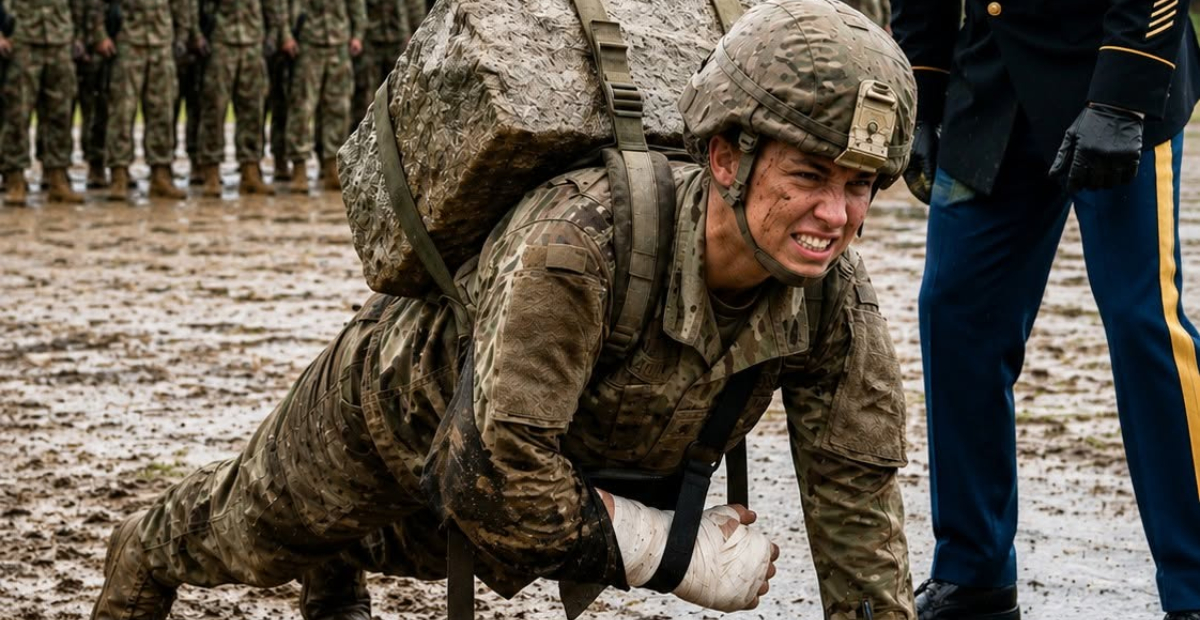
The exercise was meant to break them. That was the point. Mud-covered hills, freezing wind cutting through fatigued bodies, instructors shouting over the sound of exhaustion itself. Most soldiers had already collapsed or been pulled aside for medical checks, but one recruit still stood there, swaying slightly, refusing to drop.
He was injured—everyone could see that. His leg was wrapped badly, his breathing uneven, his hands shaking every time he raised his weapon. The drill sergeant had already marked him as done. Another minute and he would be out.
“Stand down,” the sergeant ordered again, firm and final.
But the recruit didn’t obey. He adjusted his stance instead, as if pain was something to negotiate with rather than submit to. That alone made the sergeant pause. Most men at that stage didn’t think—they collapsed. This one was calculating.
The sergeant stepped closer, irritation building. “You’re finished, soldier.”
The recruit finally looked up, and there was something unsettling in his expression. Not defiance. Not fear. Focus. Cold, precise focus that didn’t match a man supposedly at his limit. Then, for the first time, the recruit spoke clearly.
“I’m not allowed to stop yet.”
Before the sergeant could respond, something slipped from under the torn collar when the recruit shifted. A second identification tag. Not standard issue. No unit markings the sergeant recognized. Just a code, stamped clean and deliberate, like it belonged to a completely different system.
The sergeant pulled it free, eyes narrowing as he read it. His face changed instantly. The irritation disappeared, replaced by something closer to disbelief.
“That designation… doesn’t exist in active personnel files,” he muttered.
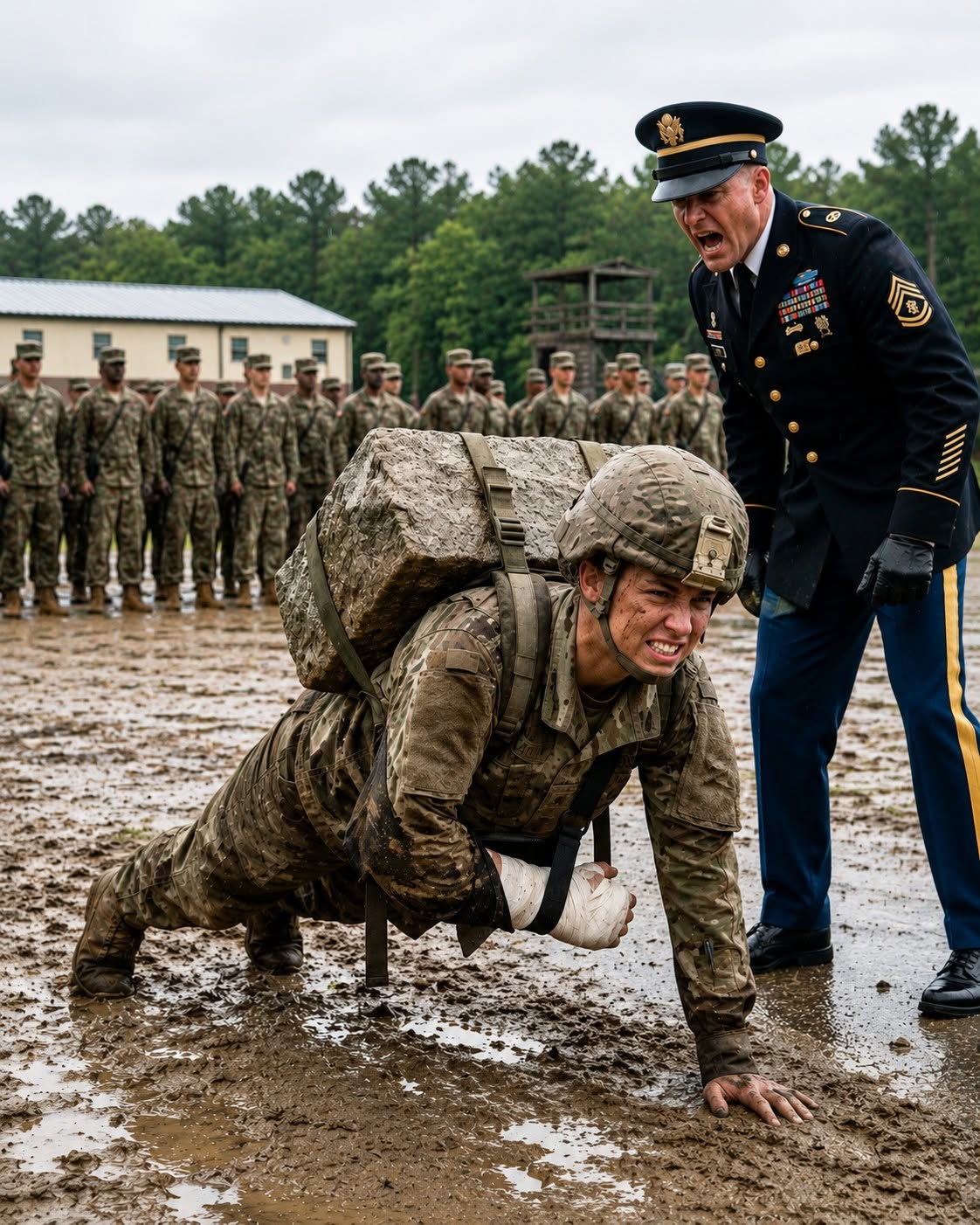
At that exact moment, the radio on his shoulder erupted with static, then a command transmission cut through the noise of the field: all training operations were to be suspended immediately. No explanation. No delay. Just urgency. And one name repeated twice—the recruit standing in front of him.
The sergeant slowly lowered the radio. Around them, movement froze. Instructors stopped. Soldiers looked up. Something had shifted in a way no one had been briefed for.
“Who are you?” the sergeant asked, more quietly now.
The recruit didn’t answer right away. His breathing steadied instead, as if the question confirmed something he had already been expecting. When he finally spoke, his voice was calm.
“That depends on what you think this exercise is.”
Within minutes, sealed personnel arrived at the field. Not trainers. Not medics. Higher command. One of them carried a black folder that looked too heavy for paper alone. It was handed directly to the sergeant without a word.
He opened it.
Inside was the recruit’s file—or what remained of it. Most pages were redacted. Others were missing entirely. But one line at the bottom was clear enough to make his stomach tighten: this individual was never assigned as a trainee. He was assigned as an evaluator.
The sergeant looked up sharply. “Evaluator of what?”
The recruit shifted slightly, wincing again as if the pain was real but manageable. “Of you,” he said simply.
Silence hit harder than any command ever could.
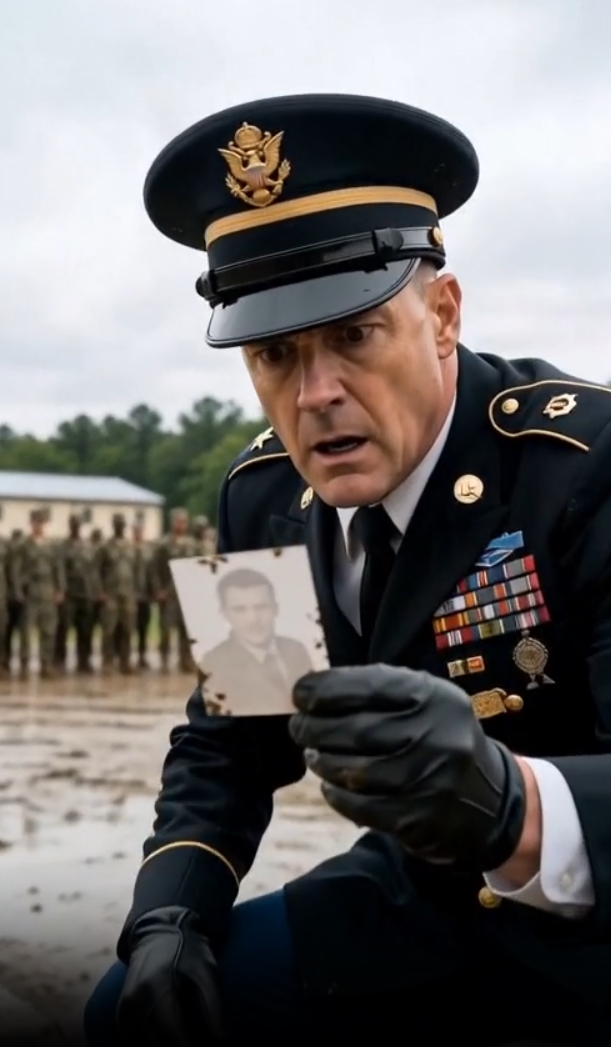
The sergeant re-read the file, forcing logic to catch up. The injuries, the endurance, the refusal to quit—it wasn’t failure. It was observation. Every order he gave, every moment he hesitated, every judgment call under pressure had been watched, measured, recorded.
“You were testing me,” the sergeant said, realization breaking through.
The recruit gave a small nod. “Not just you. Your entire unit. Your decisions under uncertainty. When to push. When to pull back. When to see beyond what you’re told.”
The sergeant looked back at the field, at the soldiers still frozen in confusion, and suddenly the training exercise didn’t feel like training anymore. It felt like a mirror he hadn’t known he was standing in front of.
“But why keep going like that?” the sergeant asked, motioning to the recruit’s injuries. “Why push yourself to the edge like that just to observe us?”
For the first time, the recruit’s expression softened slightly.
“Because people only reveal who they really are when they think someone weaker is watching,” he said. “And I needed you to believe I was weaker.”
The sergeant stood still, the weight of it settling in. The entire exercise hadn’t been about endurance alone. It had been about perception—about how leaders react when they think control is slipping.
Slowly, the recruit straightened. The pain in his posture seemed to fade, not because it disappeared, but because it had never been what it appeared to be. Around them, medical staff were already moving in, not to treat him, but to confirm status clearance.
The sergeant closed the folder. His voice was lower now.
“So what now?”
The recruit met his gaze one final time.
“Now we know,” he said. “And so do you.”
Only then did the sergeant understand the real answer had never been about the recruit at all—it was about whether he was ready for what came next.