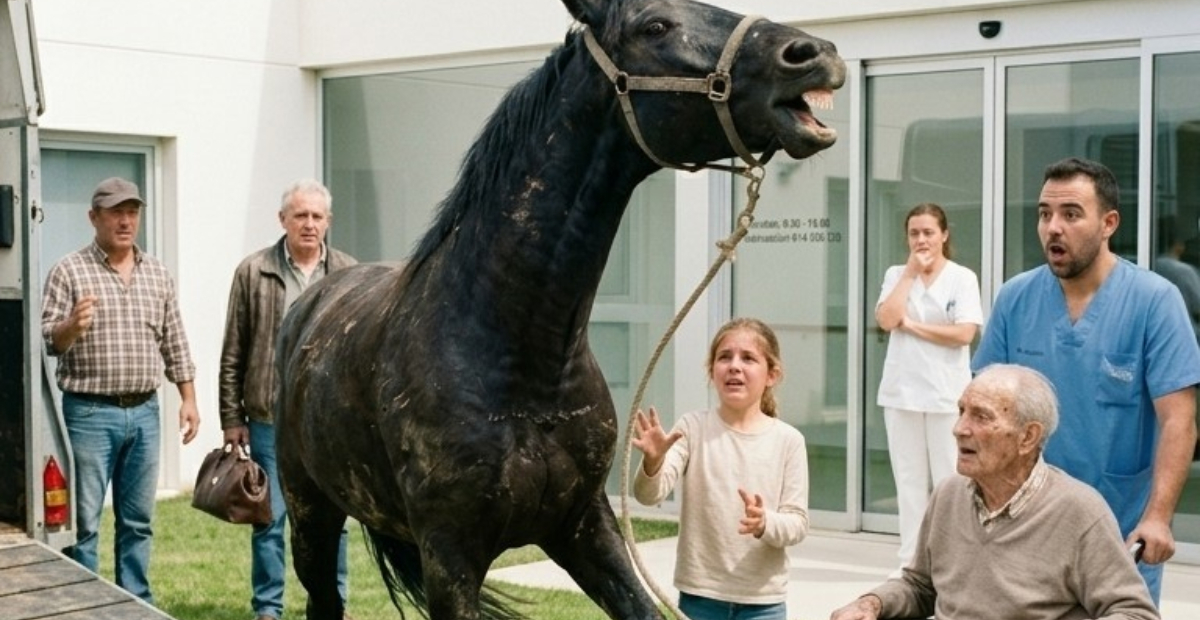
The afternoon at Maple Grove Care Home had been peaceful until the sound of frantic hooves shattered the silence. Residents enjoying the sunshine looked up in alarm as a large chestnut horse, eyes wide with fear, pulled free from its handler outside the entrance. It reared, kicked at the air, and charged back and forth across the driveway, scattering visitors and forcing staff to rush everyone to safety.
No one knew what had frightened the animal. The handler tried everything he had been trained to do, speaking calmly, holding out the lead rope, and slowly approaching, but each step only seemed to make the horse more distressed. The louder people shouted and the more they moved, the more panicked the horse became. Within minutes, everyone was convinced someone was going to get hurt.
Among those watching was ninety-two-year-old Arthur Bennett, a quiet resident who rarely spoke about his past. Confined to a wheelchair after a stroke, he usually spent his afternoons watching birds from the garden. While everyone focused on the chaos, Arthur simply observed the horse with an expression that surprised one of the nurses.
Then, before anyone could stop him, Arthur gently rolled his wheelchair toward the edge of the driveway.
Staff called for him to come back, afraid the frightened horse might charge in his direction. But Arthur calmly raised one hand, asking them not to interfere. There was something remarkably steady about him that made even the shouting begin to fade.
When he was only a short distance away, Arthur spoke in a soft, low voice.
“Easy now, Captain. Easy.”
The effect was immediate.
The horse froze. Its ears, which had been pinned back in fear, slowly lifted. The wild look in its eyes softened. Instead of pulling away, it lowered its head and took one cautious step toward the elderly man. Within moments, the animal stood quietly beside Arthur’s wheelchair, breathing heavily but no longer fighting.
The entire crowd fell silent.
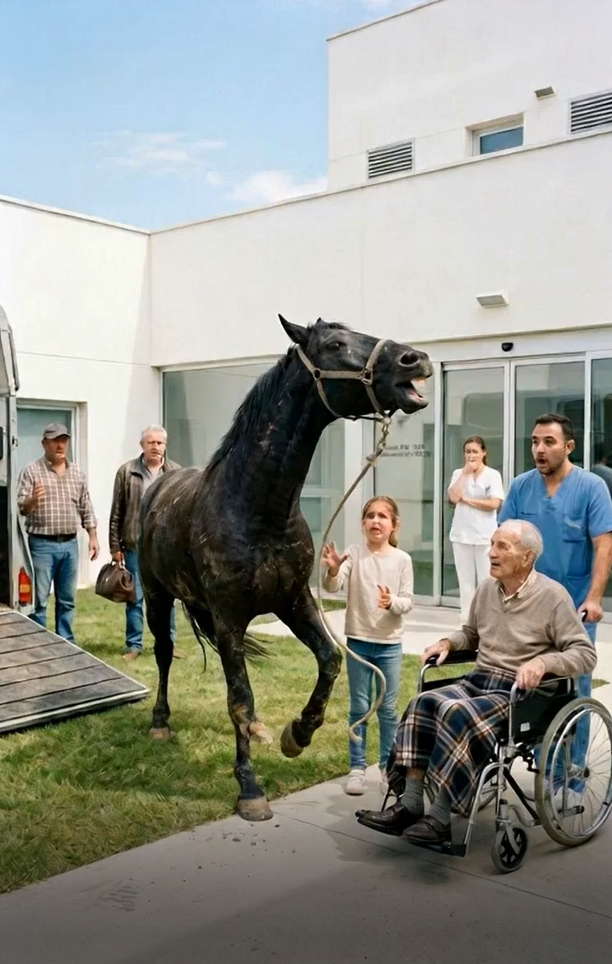
The handler carefully approached and clipped the lead rope back onto the horse’s halter without resistance. It was as if the panic had vanished completely.
No one could understand what they had just witnessed.
Later, as everyone gathered inside, the home’s manager gently asked Arthur the question everyone wanted answered.
“How did you do that?”
Arthur smiled for the first time that day.
“I didn’t calm him,” he replied. “I reminded him he wasn’t alone.”
The puzzled faces encouraged him to continue.
Arthur explained that, as a young man, he had served for decades as a cavalry trainer before later working with rescued horses that had suffered neglect or trauma. One lesson had stayed with him throughout his life: frightened horses respond less to commands than to trust. When he watched the horse’s eyes and breathing, he recognized overwhelming fear rather than aggression.
The name “Captain” had not been a coincidence either.
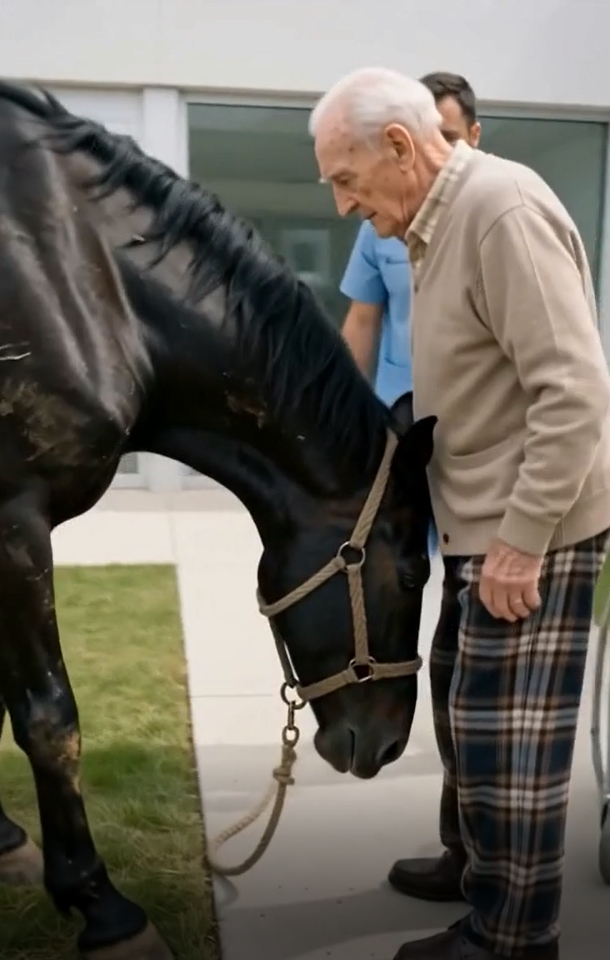
Arthur had once owned a horse by that name many years earlier. Although this wasn’t the same animal, saying the familiar name had naturally brought warmth and confidence into his voice. More importantly, he had spoken with the calm rhythm he had used with countless nervous horses throughout his career.
“The words weren’t magic,” Arthur said with a gentle laugh. “It was the feeling behind them.”
The handler later admitted that the horse had recently been rescued after surviving a serious transport accident. Loud noises and crowds still terrified him, and the commotion outside the care home had overwhelmed him completely.
Word of Arthur’s quiet act of courage spread through the community. Local newspapers shared the remarkable story, but Arthur insisted the real hero was the horse.
“He was doing his best,” he said. “Fear just spoke louder than trust for a little while.”
In the weeks that followed, the horse’s owner arranged regular visits to Maple Grove. Captain—now much calmer and growing in confidence—became a favorite among the residents, bringing smiles to faces that had rarely lit up in years. Arthur would greet him with the same gentle voice every visit, and the horse would always lower his head as if greeting an old friend.
For many people, the most unforgettable part of that extraordinary afternoon was not that an elderly man in a wheelchair had stopped a terrified horse. It was the quiet reminder that compassion, patience, and understanding can sometimes succeed where strength and force never could.